Solar panel grants in the UK: what is real, and what isn't
Is there a government grant for solar panels? For most homes, no.
There is no general solar grant anywhere in the UK for households that can pay. There are two low-income routes that can include solar, in England and Wales; a government loan scheme; a VAT relief with an end date; and payments for the electricity you export. Here is each one, with the conditions, checked at source on 2 and 3 November 2026.
England Warm Homes: Local Grant Can include solar, with conditions. Open
Run by councils for privately owned homes with an EPC rating of D to G and a household income usually of £36,000 or less, or an eligible postcode or benefit.
Solar panels can be included; a battery only alongside solar. The council organises and pays its own contractors.
Wales Warm Homes Nest Can include solar, with conditions. Open
For low-income owners and private tenants: a means-tested benefit and a low EPC rating, or a route for people with certain health conditions.
Packages can include rooftop solar panels. The Nest team arranges the work through its own installer network.
Scotland Home Energy Scotland Does not fund solar panels. Open
Solar panels were funded up to June 2024. Now only hybrid PV-T panels are supported, by a loan rather than a grant.
Heat pumps are still supported, with eligibility conditions; batteries are not listed.
England and Wales Boiler Upgrade Scheme Does not fund solar panels. Open
Pays towards heat pumps and biomass boilers. It never pays for solar panels or batteries.
Often confused with solar funding because the same installers fit both.
Which routes are worth checking for your home?
Five answers, and the checker sorts every route into worth checking, a loan, real but not a grant, or not for you. It doesn't decide anything: each scheme makes its own decisions, and the links take you to the details.
- Worth checkingWarm Homes: Local Grant: Worth checking with your council: it organises and pays for agreed work.
- A loanWarm Homes Loan Scheme (a loan): Borrowing you repay, through participating lenders and their checks. Not a grant.
- Not a grant, but real0% VAT on installed solar: A tax relief, not a grant: 0% on installation in a home until 31 March 2027, then 5%.
- Not a grant, but realSEG export payments: Income for exported units from a supplier, not a grant (Great Britain only).
- Not availableECO4: Closes on 31 December 2026 with no successor scheme; do not plan around it.
- Not for youWarm Homes Nest (Wales): Wales only.
- Not for youHome Energy Scotland: Scotland only.
- Not for youBoiler Upgrade Scheme: Pays towards heat pumps and biomass boilers, never solar panels or batteries.
A guide to where to look, not a decision: each scheme decides eligibility itself. Nothing you choose here is sent anywhere.
Why "solar grant" searches mostly end in a no
In short: government support for home solar in 2026 is aimed at lower-income households, delivered through councils in England and the Nest scheme in Wales, and otherwise takes the form of a loan scheme, a VAT relief that ends on 31 March 2027 and export payments. If your household income is above about £36,000 and your home's EPC rating is C or better, none of the grant routes is likely to apply.
The Warm Homes Plan, published in January 2026 with just under £15 billion of public money, made the direction clear: help for ordinary households comes as loans, and grant money goes to lower-income homes. No new grant for solar, batteries or heat pumps was created for households that can pay; the Boiler Upgrade Scheme continues for heat pumps only.
The rest of this site takes each route in turn: Warm Homes: Local Grant for England, the nation-by-nation picture including Nest and Home Energy Scotland, the loan scheme, and the "government grant" claim itself.
The picture changes at each border
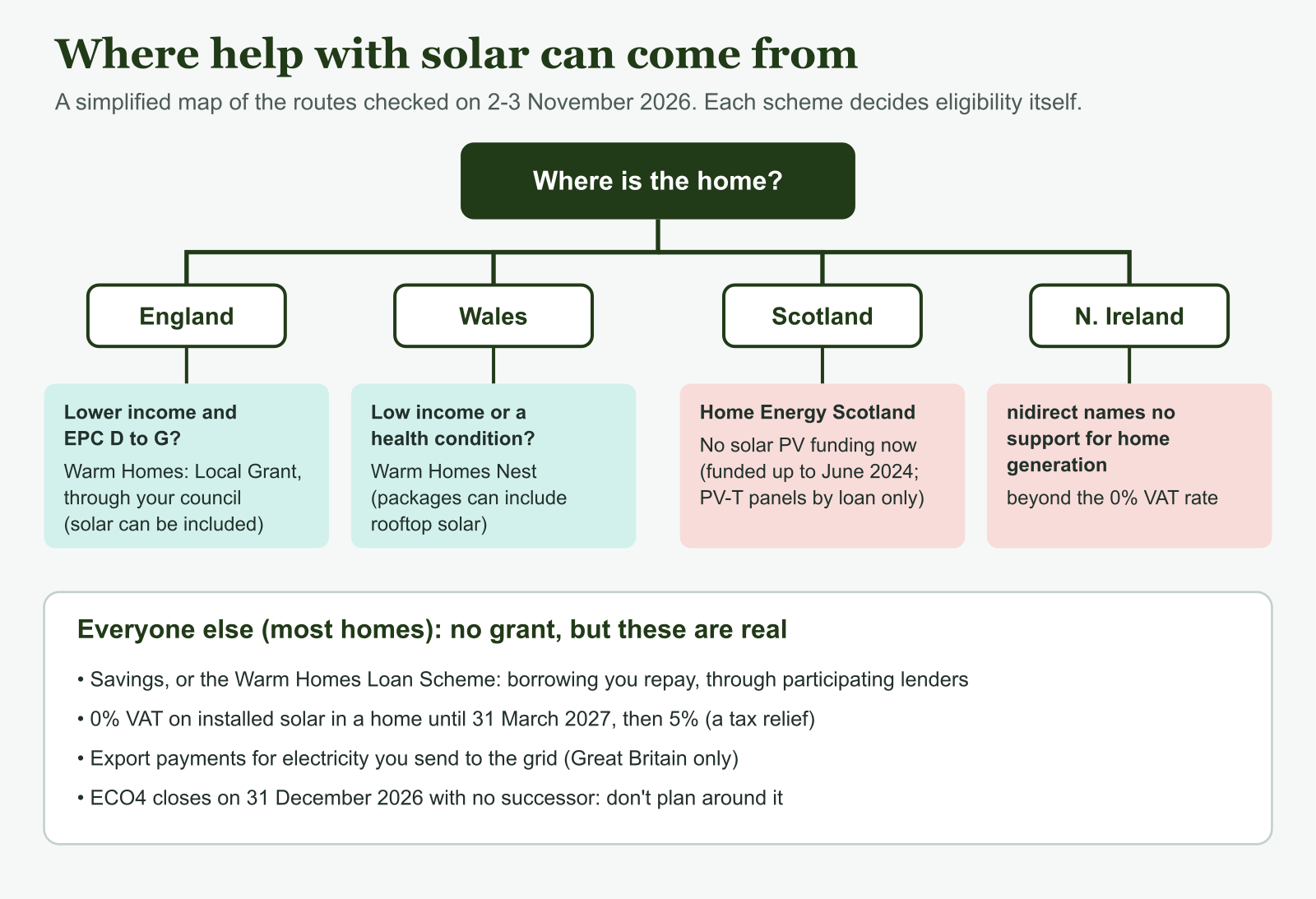
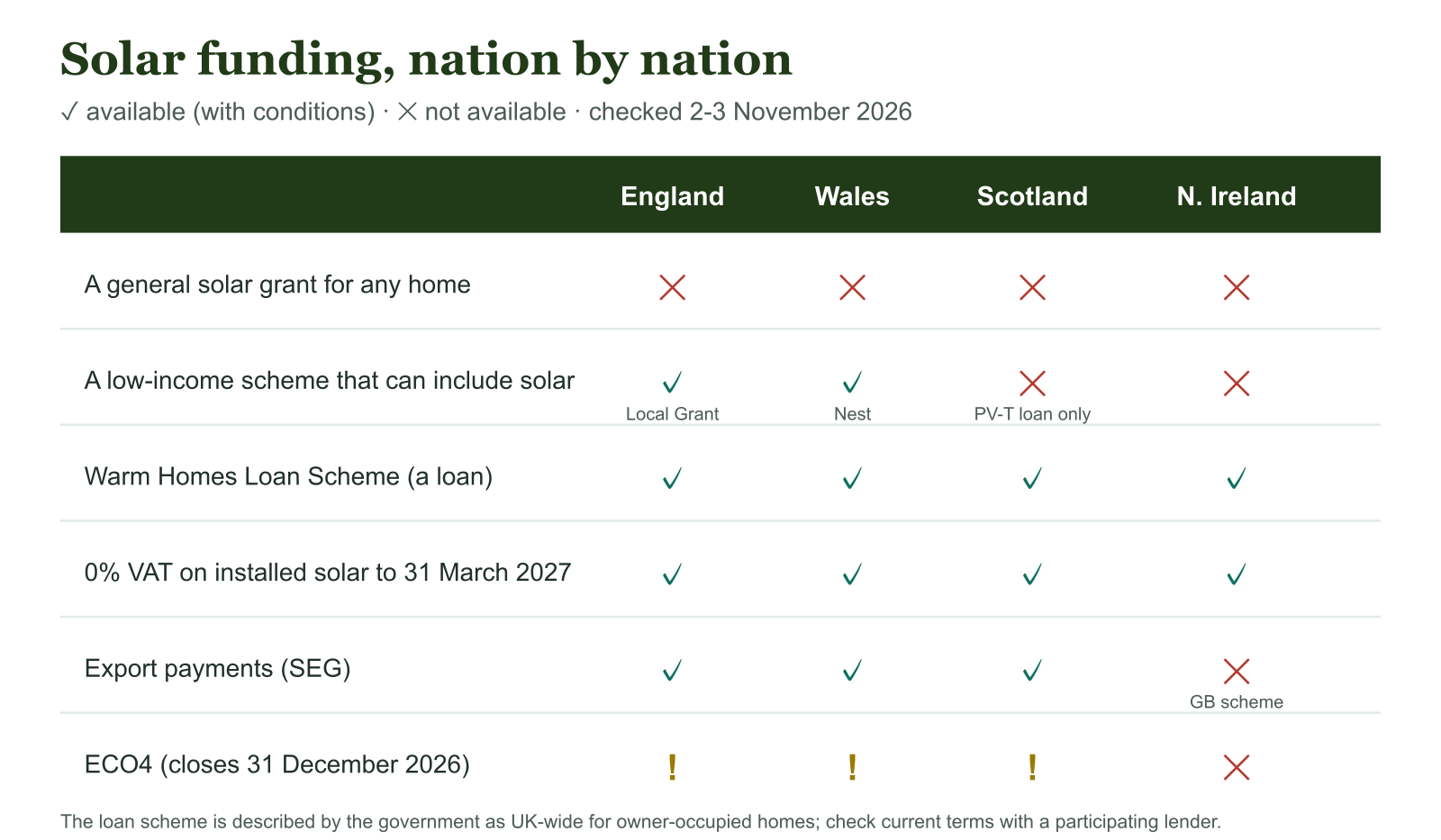
England has Warm Homes: Local Grant, run by councils until 31 March 2028, which can include solar for eligible lower-income homes. Wales has Warm Homes Nest, which can include rooftop solar for low-income owners and private tenants. Scotland's Home Energy Scotland funded solar panels up to June 2024 and now supports only hybrid PV-T panels, by loan. In Northern Ireland, nidirect names no financial support for homeowners generating their own electricity beyond the zero VAT rate.
Two things apply more widely: 0% VAT on installed solar in a home until 31 March 2027, and the Warm Homes Loan Scheme, which the government describes as UK-wide for owner-occupied homes. Export payments under the SEG apply in Great Britain. Funding by nation has the detail and the sources.
Three things that genuinely lower what solar costs you
None of these is a grant, and calling them one is how misleading offers start. All three are real, dated and checkable.
Without a grant, it helps to think of solar as buying electricity in advance: you pay once, or over a loan, for equipment that then supplies part of your home for many years. The sums rest on the price, how much of the output you use yourself, and what exports earn. Paying for solar without a grant.
The VAT relief. HMRC's Notice 708/6 zero-rates the installation of solar panels in a home until 31 March 2027; from 1 April 2027 the rate is 5%. VAT relief on solar explains what it covers and what it doesn't.
The loan scheme. The Warm Homes Loan Scheme finances solar, batteries and heat pumps through participating lenders; the government says interest is lower than ordinary borrowing. It is repaid like any loan. See the loan scheme.
Export payments. Under the SEG, licensed suppliers must offer a rate above zero for electricity you export, if the installation is certified and metered. It is income for exports, not money towards the panels. See export payments.
What changes between now and 2028
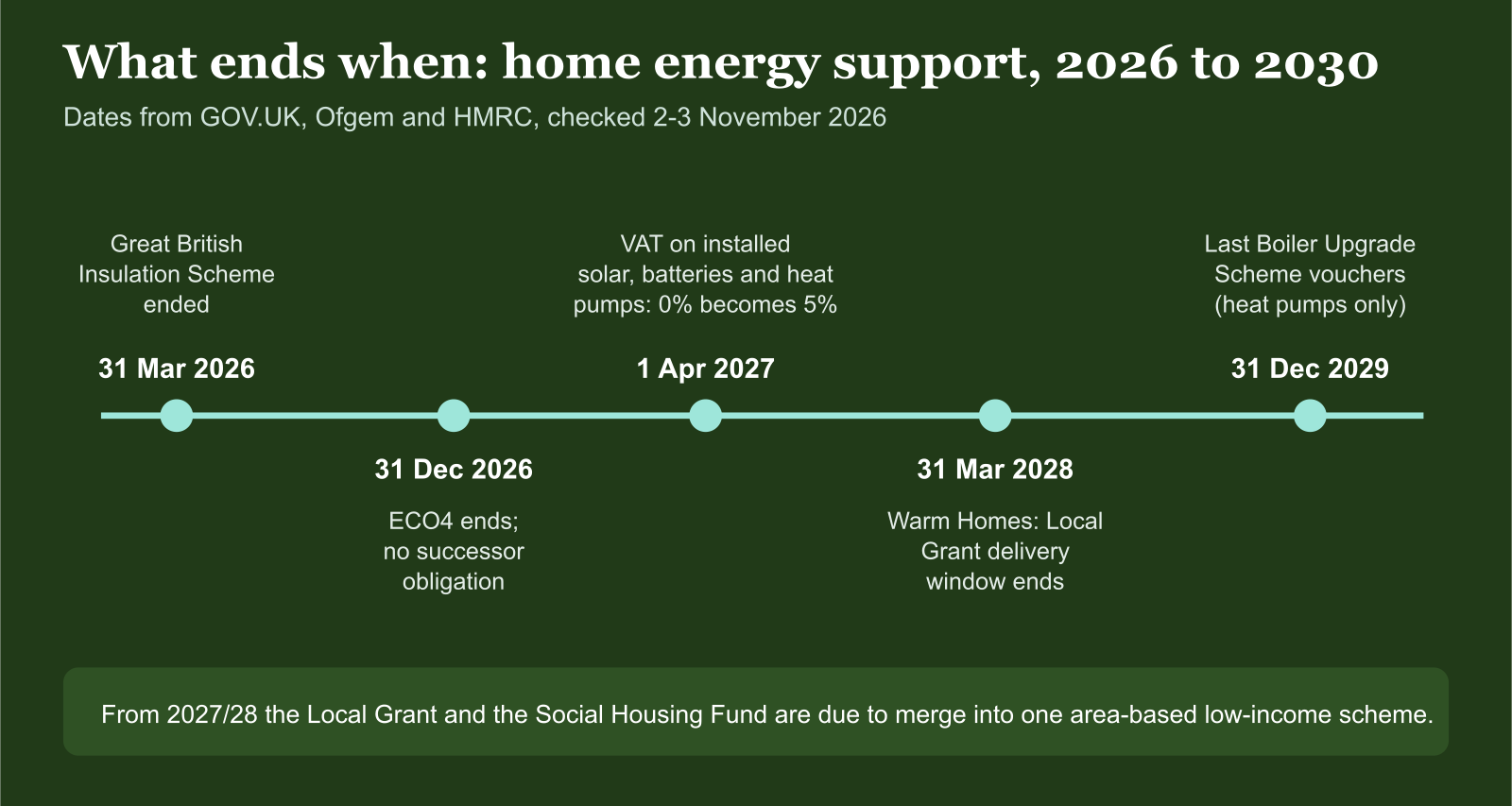
Home energy support is in transition, and several dates fall close together. The Great British Insulation Scheme ended on 31 March 2026. ECO4 ends on 31 December 2026, with no successor obligation on energy suppliers. The 0% VAT rate on installed solar, batteries and heat pumps becomes 5% on 1 April 2027. Warm Homes: Local Grant runs to 31 March 2028, and from 2027/28 it is due to merge with the Social Housing Fund into one area-based low-income scheme.
None of those dates is a reason to rush into a contract. They are reasons to be wary of anyone selling a scheme that is closing, and to check which rules will apply on the date your work is invoiced. The funding timeline lays them out with sources.
How misleading grant offers work
The Advertising Standards Authority has upheld complaints against advertisers that presented ECO4 offers as if run by GOV.UK, with crown imagery, implying government endorsement, and, as long ago as 2019, against a "Government Solar Checker" lead-generation site that implied government funding. Since April 2025 the Digital Markets, Competition and Consumers Act has banned outright the false claim of approval by a public body and the use of "free" for anything the buyer pays for.
Genuine routes don't need a cold call. Warm Homes: Local Grant is arranged through your council; Nest through the Welsh Government's scheme team. If an offer says it is a government scheme, find the scheme on GOV.UK or gov.wales yourself and contact it directly. Spotting fake grant offers and offers called free go further.
What a genuine route looks like
- You apply to, or are contacted by, the council or scheme itself, and can check that on its official website.
- Eligibility is stated plainly: income, benefits, EPC rating, where you live.
- The work is done by the scheme's own contractors, and you are told who they are.
- No one asks for an upfront fee to "secure" a grant.
Questions to ask at each step are in before agreeing funded work. For the energy performance certificate that several schemes rely on, see EPC ratings and funding.
Solar panel grant questions
Is there a government grant for solar panels?
Not for most homes. There is no general grant for solar panels for households that can pay, in England, Wales, Scotland or Northern Ireland. Some lower-income homes can get solar through Warm Homes: Local Grant in England or Warm Homes Nest in Wales.
Who can get Warm Homes: Local Grant?
Privately owned homes in England with an EPC rating of D to G and a household income usually of £36,000 or less, or an eligible postcode or benefit. Councils run it and decide which measures, which can include solar panels, each home gets.
Is the Warm Homes Loan Scheme a grant?
No. It is a loan you repay, offered through participating lenders with their own checks. The government says the loans carry lower interest than ordinary borrowing; this site does not name lenders or quote rates.
Is ECO4 still paying for solar panels?
ECO4 ends on 31 December 2026, and the government has said there will be no successor supplier obligation. The extension exists only so suppliers can finish existing work, so it is not a route to plan around.
Is 0% VAT on solar a grant?
No, it is a tax relief. Installing solar panels in a home is zero-rated for VAT until 31 March 2027; from 1 April 2027 the rate becomes 5%. Panels bought without installation are charged at the standard rate.
Are offers of no-cost solar panels genuine?
Be careful. Genuine low-income schemes are arranged through councils or official scheme teams, not cold calls. Many offers described as free turn out to be loans, roof rental or ECO4 work that is closing. Our page on offers called free explains what to check.
Where these facts come from
- GOV.UK — The Warm Homes Plan (January 2026) — checked 3 November 2026
- GOV.UK — Apply for Warm Homes: Local Grant (England) — checked 2 November 2026
- DESNZ — Warm Homes: Local Grant policy guidance, July 2026 (PDF) — checked 3 November 2026
- Welsh Government — Warm Homes Nest scheme annual report 2024 to 2025 — checked 2 November 2026
- Home Energy Scotland — grants and loans — checked 2 November 2026
- Scottish Government — FOI release on Home Energy Scotland solar funding (August 2026) — checked 2 November 2026
- nidirect — support to generate your own electricity — checked 20 October 2026
- GOV.UK — Boiler Upgrade Scheme: what you can get — checked 3 November 2026
- GOV.UK — Warm Homes Loan Scheme factsheet (27 October 2026) — checked 3 November 2026
- Ofgem — Energy Company Obligation (ECO) — checked 2 November 2026
- GOV.UK — Extending the ECO4 end date: government response — checked 2 November 2026
- HMRC — VAT Notice 708/6, energy-saving materials — checked 3 November 2026
- GOV.UK — Smart Export Guarantee — checked 3 November 2026
- ASA — ruling on ECO4U Ltd (ECO4 adverts styled as government), December 2024 — checked 2 November 2026
- ASA — ruling on Rock Paper Click Ltd ("Government Solar Checker"), November 2019 — checked 2 November 2026
- legislation.gov.uk — DMCC Act 2024, Schedule 20 (banned practices) — checked 2 November 2026
- House of Commons Library — briefing CBP-9585 on home energy support (PDF) — checked 2 November 2026
Not sure which route, if any, fits your home?
Tell us where you live and what you are looking into. Your message reaches SEO-DONS LTD, the publisher of this explainer, and we answer by email. We are not a scheme and cannot approve anything, but we can point you to the right door.
What happens next
- Your message reaches SEO-DONS LTD, which publishes this explainer.
- We reply by email with the scheme or council page that fits, if there is one.
- Any application is between you and that scheme.